Before correcting, verify whether the action is supported.
INSACERMO explores a decision layer: if the geometric signal is too low, the system abstains. The goal is not to correct everything, but to reduce actions qui cassent.
Une piste contre le calcul aveugle.
If an intervention can be refused before it costs computation, there is potential to save GPU time, energy and trial cycles. That potential must remain measured, verifiable and replicated.
Progression publique.
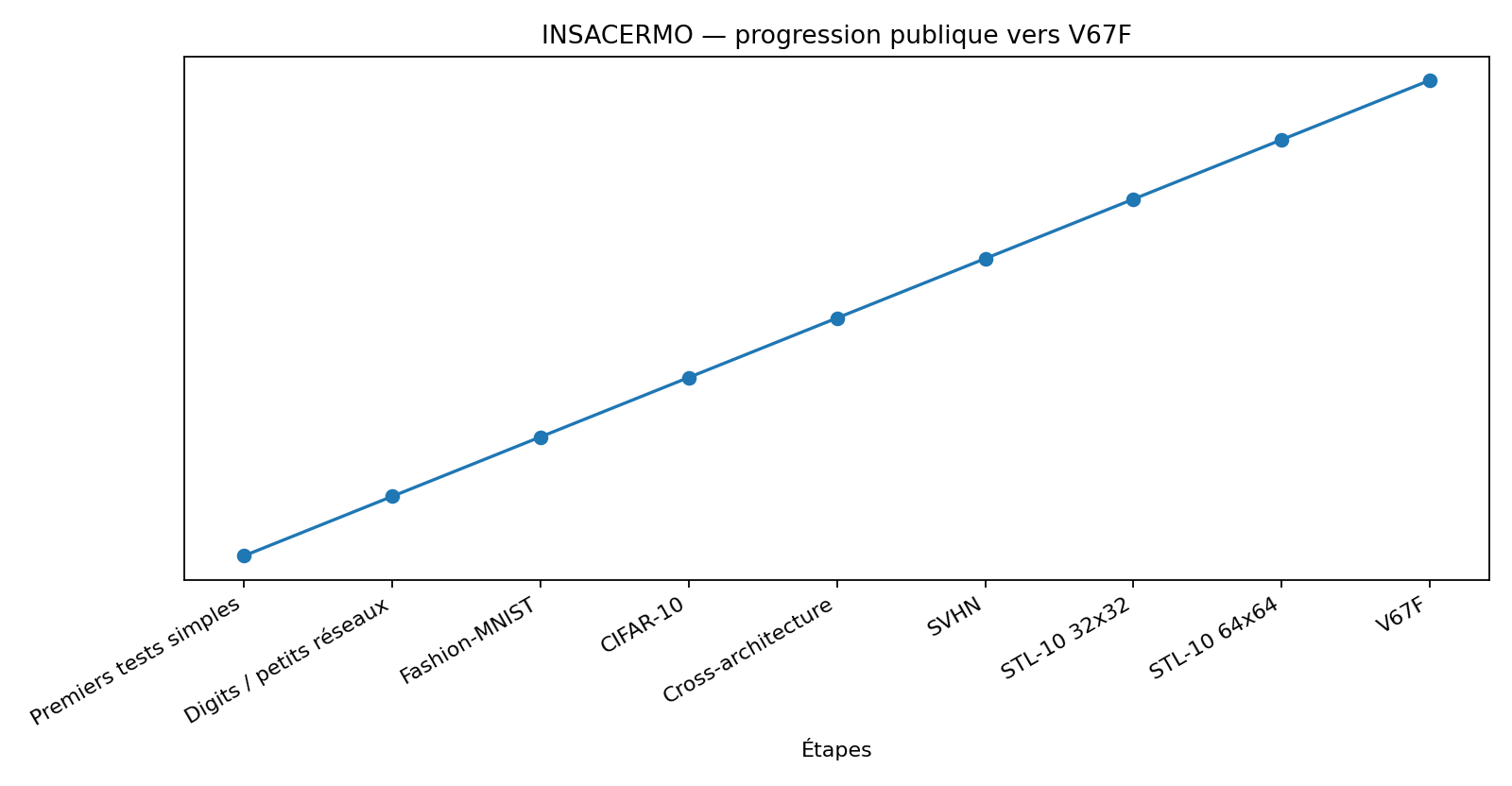
Petits tests
Minimal repair starts with controlled cases: measure before acting.
Light vision
Digits, Fashion-MNIST, CIFAR-10 : verify whether the signal survives beyond a trivial toy case.
Cross-architecture
Test whether a minimal decision can cross different architectures.
SVHN / STL-10
Move toward RGB and natural images, with more demanding controls.
64x64 resized
Ne pas dire STL-10 natif 96x96 : le protocole public V67F travaille en 64x64 resized.
V67F
HARD keeps 0 harm and removes the dangerous action that controls let through.
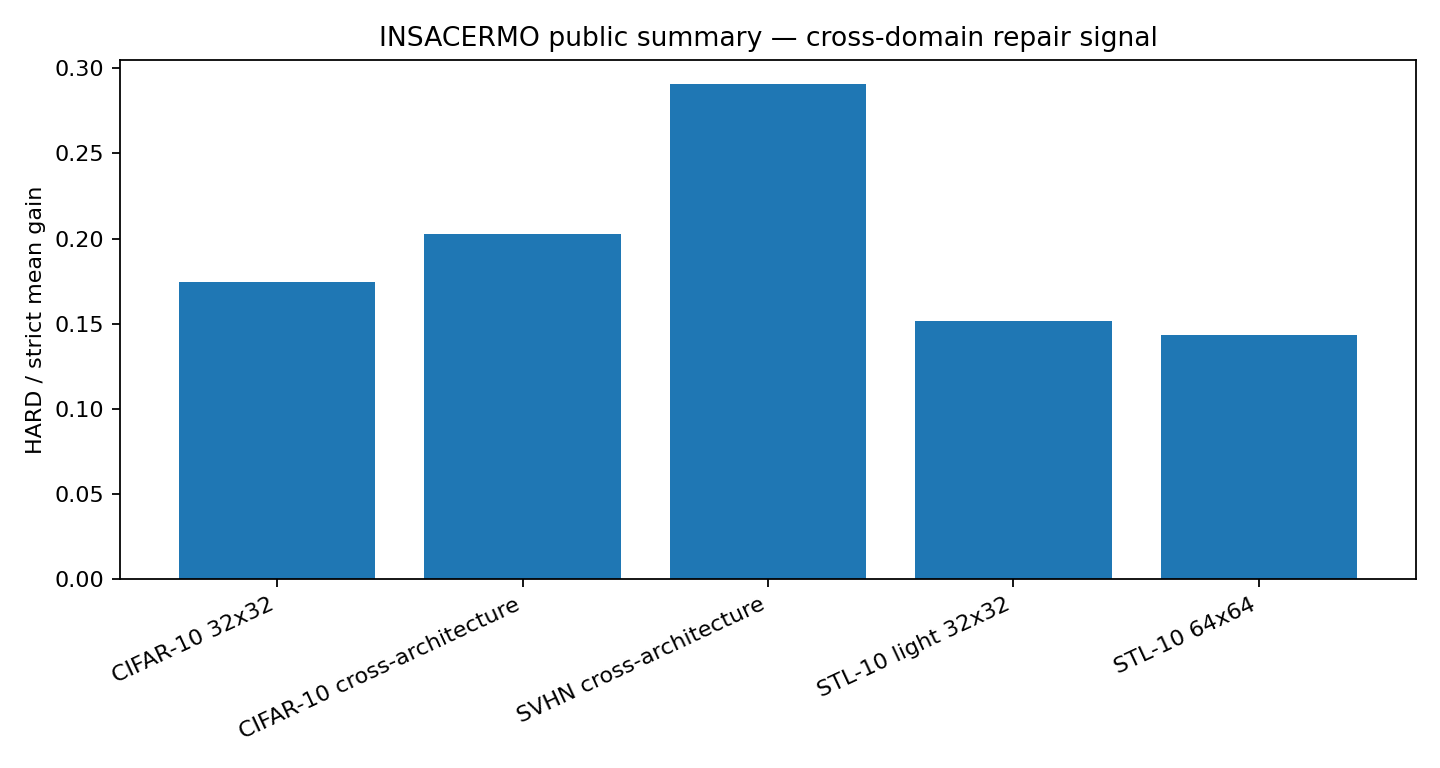
A serious signature, not yet a total law.
Ce qui fascine ici, c'est la forme de refus : HARD agit moins brutalement, mais laisse moins passer d'actions dangereuses. C'est exactement l'esprit INSACERMO : retrouver de la marge against black boxes, without promising more than the protocol shows.