0 harm
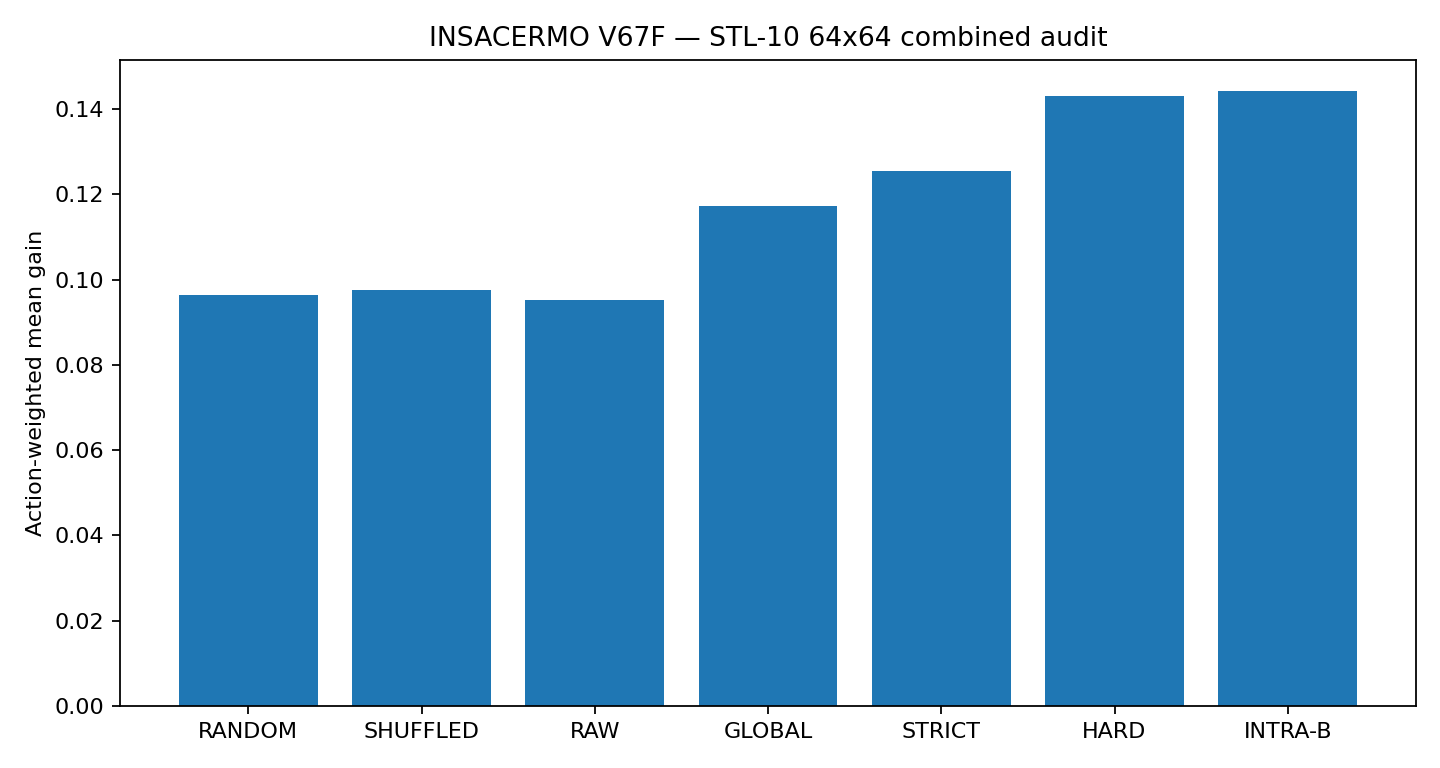
In the combined V67F audit, HARD removes the dangerous action observed in the controls.
1 harm each
RAW, RANDOM and SHUFFLED each let one harm through in the combined public audit.
positive minimum
HARD keeps a positive minimum gain in this protocol while refusing the risky intervention.
What V67F shows.
V67F combines V67D and V67E on resized STL-10 64x64. The main result is not a promise of universal performance: it is the safety of abstention.
INSACERMO does not try to repair everywhere. It tries to recognize zones where a minimal intervention seems supported by geometry, and zones where it is better to do nothing.
This result does not replace training.
It explores a geometric decision layer able to refuse risky interventions. The potential value is clear: fewer useless trials, less blind computation, and less GPU spent when the signal says to abstain. This gain remains experimental and must be replicated.
Not a total law.
V67F is not a universal industrial proof, not a native 96x96 STL-10 benchmark, not magic and not a replacement for fine-tuning. It is a public experimental result on minimal cross-architecture repair.
Verify.
The files below come from the public V67F pack. They allow inspection of results, progression and notebooks without exposing private documents.